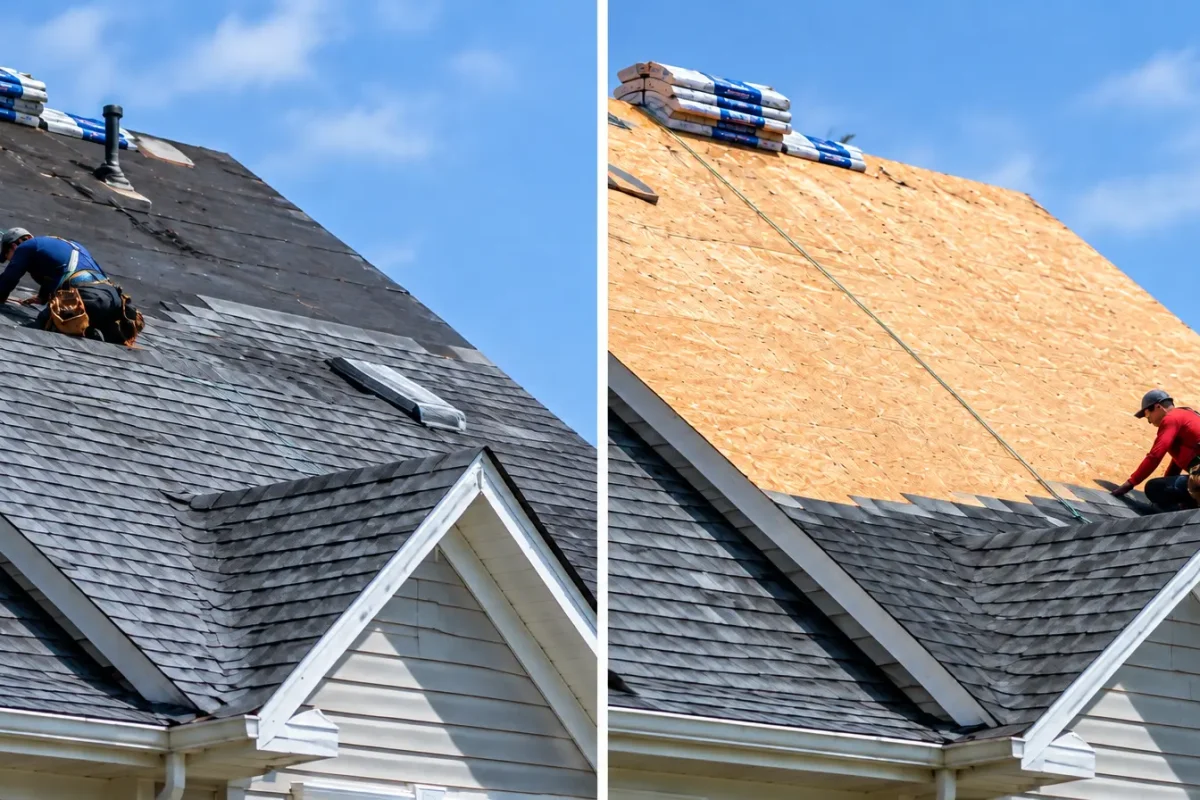
Re-roofing vs. roof replacement comes down to one question: do you install new shingles over the old roof, or tear everything off down to the deck? A re-roof, also called an overlay or roof recovery, typically costs about 15–30% less up front than a full tear-off replacement, but it only works on some roofs and often shortens the new roof’s life. This guide by Equinox Roofing explains the difference, what each option costs, when California code allows an overlay, and how to decide.
What Is the Difference Between Re-Roofing and Roof Replacement?
Roof contractors use these terms loosely, so the first step is to agree on what is actually being sold.
| Term | What it usually means |
|---|---|
| Re-roofing | Any project that puts a new roof covering on an existing roof, either by overlay or by tear-off |
| Roof recover (overlay) | New shingles installed directly over one existing layer, with no tear-off |
| Tear-off | Removing the old roofing down to the roof deck |
| Reshingle | New shingles on the same roof; it can mean either an overlay or a tear-off, so ask which |
| Roof replacement (new roof) | Full tear-off, deck inspection and repair, new underlayment, flashing, and shingles |
When a bid says “reshingle,” ask whether the old layer is coming off, what happens to the underlayment and flashing, and how deck repairs are priced. That one question separates an overlay from a true replacement.
Re-Roofing vs. Roof Replacement Cost
The main savings in an overlay come from skipping tear-off labor and disposal, which contractor guides put at roughly $1–$2 per square foot. Overall, an overlay typically costs about 15–30% less up front than a tear-off on the same roof. On a roof that would cost $20,000 to replace, that is roughly $14,000–$17,000 for an overlay. That example is illustrative only.
| Factor | Re-roof (overlay) | Roof replacement (tear-off) |
|---|---|---|
| What happens | New shingles over one existing layer | Old roofing removed to the deck, deck inspected and repaired, new underlayment and shingles |
| Up-front cost | About 15–30% less | Higher |
| Deck inspection | Not possible; problems stay hidden | Full inspection and repair |
| Typical lifespan | Often shorter, because the old layer holds heat and gives an uneven base | The full expected life of the shingle type |
| Warranty | Manufacturer terms vary and may be limited | Strongest manufacturer coverage |
| Time on site | Often a day or two shorter | Longer |
| Allowed when | One layer, sound deck, asphalt shingles | Any roof, and required in many cases |
The lower price can be misleading once you count the roof’s life. A $20,000 replacement that lasts 25 years costs about $800 per year of service. A $15,000 overlay that lasts 17 years costs about $880 per year, and the next owner still has to remove two layers. Those figures are illustrative, but the pattern is why most roofing professionals recommend a tear-off when the roof will be kept long term.
A full replacement also gives you a firm number, which makes the roof replacement cost in the Bay Area range easier to compare against bids.
When California Code Allows Re-Roofing Over an Existing Roof
Under the California Residential Code and California Building Code, a repair is not permitted where any of these conditions apply:
- The existing roof or deck is water-soaked or deteriorated to the point that it is not an adequate base for new roofing.
- The existing roof covering is slate, clay, cement, or asbestos-cement tile.
- The existing roof already has two or more applications of any type of roof covering.
In practice, that means an asphalt shingle roof with a single sound layer can be a candidate for an overlay, and almost everything else needs a tear-off. Local building departments can add requirements, so confirm with yours. Either option needs a permit, and San Francisco reroofing permits have their own online and plan-review paths.
Older homes often already carry a layer or two of roofing, a common issue on older homes in Walnut Creek, which is why counting layers is the first check on any bid.
Pros and Cons of Re-Roofing vs. Roof Replacement
Re-roofing (overlay) pros
- Lower up-front cost
- Faster installation
- Less noise, debris, and landfill waste
Re-roofing (overlay) cons
- Hides deck damage and moisture problems
- Adds weight to the roof structure
- Traps heat, which can age the new shingles faster
- Can leave an uneven surface because the old shingle pattern shows through
- May limit the manufacturer’s warranty
- Makes leaks harder to trace and the next tear-off more expensive
- Is not allowed on many roofs
Roof replacement (tear-off) pros
- The deck is inspected and repaired
- New underlayment, flashing, and ventilation details
- The strongest warranty and the longest lifespan
Roof replacement (tear-off) cons
- Higher up-front cost
- More time, noise, and debris
- Deck repairs found after tear-off add cost
Which Is Right for Your Home? Re-Roofing or Roof Replacement
An overlay can make sense when all of the following are true: the roof has only one layer, the shingles are flat and sound, there are no leaks or soft spots, the deck is documented as sound, and you have a short-term reason to save money, such as selling soon.
Tear-off is the better choice when any of these apply:
- The roof already has two or more layers
- You see leaks, stains, sagging, or curling and cupping shingles
- The roof is tile or slate
- You plan to keep the home 15 years or more
- You want the full manufacturer warranty
If the damage is limited to one area on a roof with years left, a repair may be all you need, and the repair versus replacement decision turns on age, how much of the roof is affected, and whether moisture reached the deck. A professional roof inspection that counts layers and checks the deck for moisture settles which category your roof is in.
How to Get Accurate Quotes for Re-Roofing vs. Roof Replacement
Ask each contractor to price both options on the same written scope, and make sure every bid states:
- Number of existing layers. It should be written into the contract.
- Deck condition and repair pricing. Unit prices for rotted sheathing avoid disputes.
- Tear-off and disposal. Say whether they are included.
- Underlayment, flashing, and ventilation. These should be new on a replacement.
- Warranty. Ask for the manufacturer warranty terms for an overlay versus a tear-off in writing, plus the contractor’s workmanship warranty.
- Permit. Confirm who pulls it and schedules inspections.
FAQs
- What is the difference between re-roofing and roof replacement?
Re-roofing covers any new roof covering on an existing roof, including an overlay over one old layer. Roof replacement means removing the old roofing to the deck, repairing the deck, and installing a full new system. - Is re-roofing cheaper than roof replacement?
Up front, yes. An overlay typically costs about 15–30% less because it skips tear-off labor and disposal. Over the roof’s life, it is often not cheaper, because overlays usually last less time and make the next tear-off more costly. - How many layers of shingles can a roof have in California?
California code does not allow a re-roof where the roof already has two or more layers of roofing, so in practice a roof can have at most two. Slate and clay or cement tile roofs cannot be overlaid at all. - Can you put new shingles over old shingles?
Sometimes. It is allowed in many places only over one layer of sound asphalt shingles on a dry, sound deck, and local rules vary, so confirm with your building department. - Does re-roofing void the shingle warranty?
It depends on the manufacturer and product. Some limit or reduce coverage for overlays, so get the warranty terms for an overlay in writing before you decide. - What does reshingle mean compared with a new roof?
Reshingle usually means installing new shingles on the existing roof, and it can mean an overlay or a tear-off. A new roof means full replacement with deck inspection, underlayment, and flashing, so ask what a bid includes. - Do I need a permit to re-roof?
Generally yes. Both overlays and tear-offs need a permit in most Bay Area cities. San Francisco requires one before you install, repair, or remove roofing material.
Get an Honest Answer on Re-Roofing vs. Roof Replacement
Equinox Roofing Solutions, based in Walnut Creek, has completed 1,000+ roofs, holds a 4.9★ rating on Google and Yelp, and backs its work with a 10-year workmanship warranty. Our residential roofing services include inspections that count layers and check the deck before we recommend an overlay or a tear-off, and a free roof inspection gives you a written answer for your own roof.